The Gift that Keeps On Giving
May 15, 2016
Christ Church Episcopal, Norcross, GA
Day of Pentecost
Genesis 11:1-9; Acts 2:1-21; John 14:8-17, 25-27
I’d like to see a show of hands… how many of you have a birthday that falls during the summer months? I have a summer birthday. It’s in late July.
Summer birthdays are different than school-year birthdays. If you were like me, your birthday parties probably had fewer school friends, who were scattered for the summer. Instead, you’d have kids from the neighborhood pool and family. When I was young, I always wanted a school-year birthday because it seemed like they got more attention. I contend this isn’t just true for our personal birthdays, but also for the birthday of the church.
That’s what today is after all – Pentecost Sunday! The Birthday of the Church.
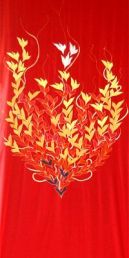 Now, unlike our birthdays which fall on the same date each year, Pentecost falls on different days because it’s always 50 days after Easter and Easter moves around. This year Easter was pretty early, so while Pentecost is usually a summer-birthday-kind-of-day, this year it’s been upgraded to a school-year birthday! So instead of a lot of folks being scattered, we’re all here to celebrate together!
We’ve got our festive red outfits on, our flamed-ribbon-sticks in-hand, a dove flying in the procession, special music – the works! It’s quite a birthday celebration for the Church!
But why is Pentecost considered the birthday of the church?
Hold onto Hope
March 25, 2016
Christ Church Episcopal, Norcross, GA
Good Friday
Isaiah 52:13-53:12; Hebrews 10:16-25; John 18:1-19:42; Psalm 22
Today is a dark day. Even when the sun is beaming brightly outside, we draw the shades; we dim the lights; we wear dark clothing; we speak in hushed tones; we kneel before a stripped altar. It is the day of remembering Jesus on the cross. We consider our part in the drama that unfolded thousands of years ago.
 When we journey through Holy Week, a week set-apart for remembering, even reenacting, some of the final acts of Jesus – washing the feet of his disciples, sharing the bread and wine at the table, walking the path of the cross to Calvary, and now, knelling at the foot of the cross – it’s easy, even natural, to get caught-up in the darkness of the day. Yet, it is called GOOD Friday for a reason. Although it may not seem like it to others looking in, it’s a day that holds in it great HOPE.
Discern Care – Fully
March 13, 2016
Christ Church Episcopal, Norcross, GA
5th Sunday in Lent
Isaiah 43:16-21; Philippians 3:4b-14; John 12:1-8
(Gospel text is provided at the bottom of this post)
Have you ever been out to dinner with a group of friends you’ve known for a long time, or with family, and someone starts telling a story about a shared experience that happened years earlier? You get excited because it was such a special adventure that you’ll never forget!  Then, as the story unfolds, there are variations in the storyteller’s version that don’t quite match your memory of what happened. Some of the details seem okay, but other aspects, like who actually did or said certain things, or when it happened in relation to other life-events, seem out of line. And while it isn’t exactly how you remember it, the teller is so sure of their version that there’s really no use in arguing about it. It’s their reality, after all.
We see those same kinds of variations in Biblical stories, including today’s gospel reading from John. While this story about the anointing of Jesus appears in each of the four gospels, they don’t all match up. For many people it can be confusing to have these different versions of the same story. When there are inconsistencies, it can create doubt about the validity of any of it!
Let’s Grow
February 28, 2016
Christ Church Episcopal, Norcross, GA
3rd Sunday in Lent
Exodus 3:1-15; 1 Corinthians 10:1-13; Luke 13:1-9
 Today we heard the familiar story of Moses and the burning bush. The burning bush has become the quintessential symbol of God’s call to do God’s work in the world. In the story, we’re told that Moses is tending the flock of his father-in-law, Jethro. He’s just doing an ordinary thing on an ordinary day. He’s taken the flock beyond the wilderness and finds himself at Horeb, the mountain of God. Then Moses sees something that catches his eye… a bush on fire, yet not being consumed. And what does Moses do?
He doesn’t run away. He doesn’t ignore it and return to his flock. Instead, he says “I must turn aside and look at this great sight…” Moses TURNS and takes a closer look.
[Quick Sidebar: Remember that the root of the word repentance is μετανοέω (metanoeó) – to change direction, to TURN toward God. We are in the season of Lent, so the theme of repentance, of turning toward God, is everywhere! Even in this burning bush story!]
 jodygreenwood