The Myers-Briggs of Mission
February 5, 2012
Christ Church Episcopal, Norcross, GA
Sermon on Mark 1:29-39, given while serving as seminarian
5th Sunday After Epiphany – Year B (RCL)
Isaiah 40:21-31, 1Corinthians 9:16-23 & Mark 1:29-39
Last fall I was asked if I’d come to one of the YEA group’s Sunday school classes and share my story. A few weeks before, I asked one of the leaders if there was something in particular that would be good to focus on. She explained that they’ve been talking about discernment, and discerning their own spiritual gifts, and as part of this, each of them had done the Myers-Briggs assessment – so I did one, too.
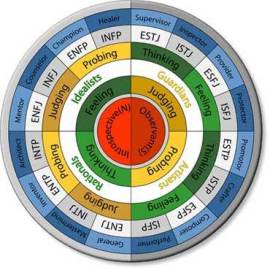 Now, Myers-Briggs has been around for a long time and many people, probably many of you, have been exposed to it. And those who have taken it invariably know their “Letters” and they’ll say things like… “I’m an ENFP,” and if you know Myers-Briggs, this is short-hand that tells you they are Extroverted, Intuitive, Feeling and Perceiving: E-N-F-P. A general description of an ENFP is that they are:
…both “idea”-people and “people”-people, who see everyone and everything as part of a cosmic whole. They want to both help and to be liked and admired by other people, on both an individual and a humanitarian level…
Sound like anyone you know??
Overcoming Fear to Claim Your Day
November 13, 2011
Christ Church Episcopal, Norcross, GA
Sermon on Matthew 25:14-30, given while serving as seminarian
A few weeks ago, as part of my Sociology of Religion class, I attended a Sabbath worship service at a local Conservative Jewish synagogue. Now, I don’t know how many of you have attended a Jewish Shabbat service, but if you find yourself looking at your watch when our service approaches the one hour mark, their 3-hour liturgy would be a real test of endurance for you. It certainly was for me!
This particular Saturday included a Bar Mitzvah. For those of you not familiar with Judaism – the term Bar Mitzvah means “Son of the Commandment.” It’s the time when a Jewish boy, having reached the age of thirteenth, is now counted among the “adults” of the Jewish tradition. [When a girl goes through this it’s called a Bat Mitzvah.] Part of this Rite of Passage includes having the youngster lead a portion of the service, including reading from the Torah, which is written in Hebrew and contains no vowels or punctuation, making it very difficult to read. They also share a short story that they’ve prepared about the Torah reading, similar to our homily. So it’s quite a bit of work.
Now that particular morning, as I was walking through a virtually empty foyer just minutes before the service was to begin, I noticed a family coming through the door. I had a sense that this was the family of the Bar Mitzvah candidate. The young boy seemed happy and self-assured – and as he walked by me I asked, “Is this your day?” He confidently replied, “This is my day.” There was no arrogance in his reply, instead, it was a kind of “claiming” that was amazing and exciting to see. His name is Jacob. Read the rest of this entry »
Have you wrestled with the cross lately?
September 14, 2011
Candler School of Theology, Atlanta, GA
Feast of the Holy Cross, September 14, 2011
2nd Year MDIV Student
Lectionary: Isaiah 45:21-25, Psalm 98, Galatians 6:14-18, John 12:31-36
A few weeks ago, on the first day of classes, Anglican Studies eagerly welcomed six more students to the program. As with any group, when new people join, there are always questions about how things work and what we do. On this particular day, knowing we would be leading Evensong & Eucharist that evening, we spent some time walking through the service.
It was only a year ago that I was going through the same thing – completely unfamiliar with sung Evensong – the Magnificat and Nunc Dimittis – and having to learn it on the fly. There I was, considered one that was leading the service, yet I was wholly unsure of what I was doing at every turn.
Now lucky for us, this year’s newbies are good at asking questions. As we went through the liturgy someone asked “When do we make the sign of the cross?” which was quickly followed by “How do you make the sign of the cross?” These are good questions, and remind us that we all have different sensibilities and experiences with this particular gesture.
For many, the only time they see this gesture is when they are watching a baseball game and the batter makes the sign of the cross as he steps up to the plate. And even though this acknowledges the same strength and protection from God through Christ, the spitting and scratching that follows is not part of our routine… or at least not intentionally.
Getting out of the boat
August 7, 2011
Emmaus House Episcopal Chapel, Atlanta, GA
Sermon on Matthew 14:22-33
Proper 14 – Year A (RCL) Genesis 37:1-4, 12-28; Psalm 105, 1-6, 16-22, 45b; Romans 10:5-15; Matthew 14:22-33
Several weeks ago, in anticipation of preaching, I took a look at the Lectionary for this Sunday. When I saw that it was the story of Jesus walking on water, I had more than a little trepidation. You see, I’m a pretty straight-forward thinker – any of you who know me, have probably noticed that about me. I like facts whenever possible… I take a very left-brain approach to situations.
Now, had the gospel lesson been a parable that Jesus was telling, that would be no problem. He taught using metaphors and storied illustrations all the time, but today’s lesson is a story pointing to something Jesus did, not something Jesus said. I like for those types of stories to be “fact-based” – told more from an historical perspective, or told in a way that makes it fairly easy to understand what happened.
You can image that with this bias, approaching scripture can be a real challenge and specifically this walking on water thing … If the story is being told by one of Jesus’ apostles, and if it isn’t factually accurate, how do we believe anything else written in the gospel of Matthew? Or any of the other gospels for that matter?
 jodygreenwood