Both Shepherd and Lamb
April 18, 2014
Christ Church Episcopal, Norcross, GA
Good Friday, April 18, 2014 – Year A
Isaiah 52:13-53:12, Hebrews 10:16-25, John 18:1-19:42
If you were here this past Sunday, you heard me explain that these narratives about Jesus’ death are called “The Passion” because the Latin root of the word is passio, which means suffering.
Throughout the Passion narrative from Matthew read on Sunday, we got a sense of the suffering Jesus endured, yet today’s account from John is quite different. In John’s gospel Jesus is the one directing the course of action, from beginning to end, and this is reflected in the Passion story, as well.
In today’s reading, after Judas brought the soldiers and temple police into the garden where Jesus was, instead of Judas kissing Jesus on the cheek, as told in Matthew’s version, here we have Jesus stepping forward on his own. He asks the soldiers who is it they seek, and when they say “Jesus of Nazareth” Jesus responds, without hesitation, “I am he.” Read the rest of this entry »
John’s Gospel: A Compelling Case
April 9, 2014
Candler School of Theology – Episcopal Studies Eucharist Service
Lent V – Wednesday
Daniel 3:14-20, 24-30; John 8:31-42
Today is my first day back from vacation… and it’s great to be back here with familiar faces at Candler after of day of working through a week’s worth of e-mails!
 I spent most of last week in the quiet of a small cottage at St. Mary’s Convent in Sewanee, TN. On Wednesday morning I ventured onto campus, just a few miles up the road, to take in 9 holes of golf and then attend the sung-Eucharist service at the seminary. And for those who might judge me for putting a bit of golf in my contemplative retreat, rest assured, God’s name was invoked more consistently in that short period of time than any other while I was on the mountain.
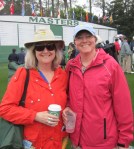 After a few days of quiet reflection, I returned home on Saturday, just long enough to unpack and re-pack before Alice and I headed east on Sunday, to another altar of sorts – the immaculate fairways of the Augusta National golf course, host of The Masters.
My sister, Nancy, was able to get tickets to Monday’s practice round and Alice and I were invited to join in the fun! Though Monday ended up being a wash-out for the golfers and fans, the flower guild is still to be commended for their amazing work! Read the rest of this entry »
Washing off the Mud of Jesus
March 30, 2014
Christ Church Episcopal, Norcross, GA
The Fourth Sunday in Lent – Year A RCL
1 Samuel 16:1-13, Ephesians 5:8-14, John 9:1-41
Last year, as part of my World Religion class at seminary we went to the Al-Farooq Mosque, on 14th Street in Midtown Atlanta, for Friday afternoon prayers. One of our guides was an active lay-minister and often preached the English-language sermon on Friday’s, which he did that day.
At one point he mentioned that whatever condition a person is born into, whether into poverty or into wealth, for example, it has its own burden to navigate. It is incumbent on each person to spend their life in prayer to God, seeking the proper use of their wealth, or seeking a way to overcome or endure their poverty.
In this same way, I believe, we are each born into circumstances of life that we must navigate. For the man in today’s gospel reading, he was born blind. Others, like my friend Claire, have been born deaf; still others are born with a predisposition for addiction; others with chemical imbalances in the brain that cause depression or anxiety; some with learning challenges, like dyslexia; and the list goes on and on.
In ancient times, being born with blindness or other debilitating conditions was believed to be a judgment by God for having sinned. But, we see in his conversation with the disciples, that Jesus dispels this notion.
I contend that in the same way that these physical conditions aren’t caused by sin, sin also doesn’t cause someone to be born into poverty any more than a lack of sin causes someone to be born into wealth. And while both have their challenges, if given the choice, I’m sure we’d much rather struggle with the burden of WEALTH.
But returning to the story of the man born blind, Jesus says that he “was born blind so that God’s works might be revealed in him.” Similarly, each condition into which we are born can also provide an opportunity for God’s work to be revealed in us.
But, just as with this man, it isn’t automatic, and it isn’t without risk and consequence.
Breaking News: Episcopalian says “Evangelism”… Come & See!
January 19, 2014
Christ Church Episcopal, Norcross, GA
2nd Sunday after Epiphany – RCL Year A
Isaiah 49:1-7, 1 Cor 1:1-9, John 1:29-42
If you were here on Christmas morning you heard me talk about God breaking into our lives with the coming of Jesus into the world. I shared my own tendencies through the years to keep my life “safe and unchanged” within the comfort of darkness. But Jesus’ presence was God’s way of turning on a new light, and once we are exposed to this light, the world appears differently and we are called to respond differently in it.
Now, with the Christmas season behind us, we face the weeks between Epiphany and Lent. It’s a time in the church year when we focus on the revelation of Jesus as the Messiah. This is a central theme of the Gospel of John, where Jesus is explicitly revealed, right up front, as the one who was sent by God and was with God from the very beginning.
In the first verses of Genesis, when darkness covered the face of the deep, God said, “Let there be light; and there was light.” And now, in John’s gospel the creation story is retold:
“In the beginning was the Word, and the Word was with God and the Word was God. He was in the beginning with God… In Him was life and the life was the Light of all people. The Light shines in the darkness, and the darkness did not comprehend it.” (Jn 1:1-2,4-5, NASB).

