Both Shepherd and Lamb
April 18, 2014
Christ Church Episcopal, Norcross, GA
Good Friday, April 18, 2014 – Year A
Isaiah 52:13-53:12, Hebrews 10:16-25, John 18:1-19:42
If you were here this past Sunday, you heard me explain that these narratives about Jesus’ death are called “The Passion” because the Latin root of the word is passio, which means suffering.
Throughout the Passion narrative from Matthew read on Sunday, we got a sense of the suffering Jesus endured, yet today’s account from John is quite different. In John’s gospel Jesus is the one directing the course of action, from beginning to end, and this is reflected in the Passion story, as well.
In today’s reading, after Judas brought the soldiers and temple police into the garden where Jesus was, instead of Judas kissing Jesus on the cheek, as told in Matthew’s version, here we have Jesus stepping forward on his own. He asks the soldiers who is it they seek, and when they say “Jesus of Nazareth” Jesus responds, without hesitation, “I am he.” Read the rest of this entry »
Palms & Passion: The Overture
April 13, 2014
Christ Church Episcopal, Norcross, GA
Palm Sunday – The Passion of Christ (Year A)
Isaiah 50:4-9a; Philippians 2:5-11; Matthew 26:36-27:66
We’ve finally arrived at Palm Sunday, also called Passion Sunday. While using the word “Passion” may seem unusual, the Latin root of this word is passio, which means “suffering.”
Palm Sunday is a sensory overload. When I attended Emmaus House Chapel, Claiborne Jones, the vicar, would say “It’s the day of the church year when we do everything that we don’t do any other time.” And there is some truth to that.
And you have to admit, the Passion story makes a powerful centerpiece. The dramatic reading of the Passion of Christ brings it more fully to life. Yet, as we heard it today, just now, we must understand its purpose on this day – which is to provide an Overture, if you will, for Holy Week.

gone-with-the-wind-1939
The Overture is that musical score at the very beginning of a musical, before the curtain goes up or during the opening credits, that weaves together small portions of various songs that will be part of the overall story.
For those who have seen the musical before, when they hear the Overture it brings to mind the context of each of the songs, drawing the audience in, heightening their anticipation of what is to follow. But, it doesn’t capture the whole story – you still have to watch the scenes that follow to get the full experience.
Similarly, the Passion story of Palm Sunday is like an Overture. It’s an overview of the story – the story that we will be participating in more fully throughout Holy Week.
For much of Christian history Holy Week was a time when people went to church every day of the week. In more recent times, there would be more active participation at least during the Triduum – which are the three days of Maundy Thursday, Good Friday and Holy Saturday. Yet even participation in these three days occurs less and less often, crowded out by busy schedules.
Consequently, Passion Sunday becomes a sort of substitute for Holy Week. It’s a shame really. It’s like listening to the Overture of a musical and then leaving the theater – you miss so much.
So, today, I invite you to enter fully into Holy Week, particularly, the Triduum. It provides an opportunity to experience the Passion of Christ more fully, and in so doing, to prepare more completely for the miracle of the resurrection. Read the rest of this entry »
The Truth of Resurrection
April 7, 2013
Christ Church Episcopal, Norcross, GA
Sermon on John 20:19-31 given while serving as Deacon & Seminarian
Second Sunday in Easter – Year C RCL
Acts 5:27-32, Revelation 1:4-8 & John 20:19-31
Last week, Ceci began her Easter sermon not with the joy of the resurrection, but first, she invited us to imagine the despair and confusion the disciples must have felt that first Easter morning. Although it’s impossible for us to fully imagine their feelings, participation in Holy Week allowed us to try…
Palm Sunday began with the triumphant entry into Jerusalem, with palm branches and hosannas. Yet, moments later, it quickly shifted to the Passion story, where we ourselves took part in the taunting cries of “Crucify Him!” On Maundy Thursday we remembered Jesus as servant, and then, followed his example by washing one another’s feet. In this act we embodied God’s message that we are to love one another. But then the tone shifted as the lights dimmed and the altar was stripped bare, like Jesus himself before his own crucifixion. On Friday we endured the three-hour vigil at the foot of the cross. Then that night, through a dramatic presentation, we were brought face-to-face with the agonizing walk and excruciating death of Jesus, ending with his burial in the tomb. On Saturday, we mourned.
A Sacrament of Love
March 28, 2013
Christ Church Episcopal, Norcross, GA
Sermon on John 13:1-17, 31b-35, given while serving as Deacon & Seminarian
Maundy Thursday
Exodus 12:1-14, 1 Corinthians 11:23-26 & John 13:1-17, 31b-35
When I was young, I used to go over to my Grandma Caldwell’s house, my mom’s mom, to spend the night. She and I would spend time together baking cookies or gingerbread. In the morning we’d often listen to Bible-quiz shows on the radio – having grown up Baptist, she knew a lot of the answers. As I got a little older, she’d play Elvis Presley records on the stereo… I think it was his gospel music that hooked her, but I preferred dancing around her small living room singing “Blue Suede Shoes.”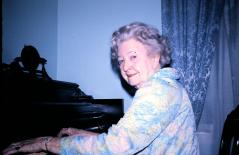
Now, Grandma Caldwell didn’t drive a car, so when we needed to get something for our latest recipe, we’d walk to a nearby store. I don’t think Grandma did a lot of walking, considering she was in her seventies, but the walking she did do, took a toll on her feet. So, it wasn’t uncommon as she was lying down to take a nap (which she invariably needed during my visits), she’d ask me to rub alcohol on her feet, and I was happy to do it.
 jodygreenwood