Re-Turning to Purpose: We Shall Not Murder
March 8, 2015
Christ Church Episcopal, Norcross, GA
The 3rd Sunday in Lent
Exodus 20:1-17; 1 Corinthians 1:18-25; John 2:13-22
When we hear this story about Jesus turning over the tables and driving the livestock out of the temple grounds, we often use this as an example of Jesus’ HUMAN nature, as opposed to his DIVINE nature. There’s something comforting when we see this other side of Jesus; a Jesus who gets mad and starts throwing things. THIS is a Jesus we can relate to!
But I contend something very different is happening in today’s story.
First off, today’s reading comes from John’s gospel, which handles this event differently than the other gospels. In Matthew, Mark and Luke, the cleansing of the temple, as it is often called, happens near the end of Jesus’ ministry. He’s entered Jerusalem for the Passover and goes to the temple. But, in these gospels, the charge that accompanies the table-flipping is that the temple has become a den of thieves. And, it is this act in the temple that becomes the catalyst for his arrest and execution.
But that isn’t how John tells it.
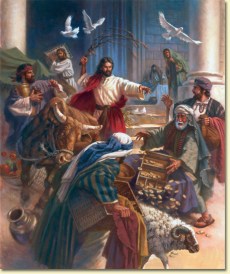
In John’s gospel, the table-turning is at the very beginning of Jesus’ ministry. Jesus has just left Cana and the infamous wedding where water has been changed into wine. Like the other gospels, he’s in Jerusalem for the Passover, but his actions in the temple grounds came not with an accusation of robbery, but instead carry an indictment that the Temple’s purpose has been usurped. They have turned a house of prayer into a marketplace. The temple had become a place of other things, and has lost its primary purpose – a place to meet God; to be connected with God.
What the Promise is For
February 22, 2015
Christ Church Episcopal, Norcross, GA
The 1st Sunday in Lent
Genesis 9:8-17; 1 Peter 3:18-22; Mark 1:9-15
Today’s Old Testament lesson is the very end of the story of Noah and the ark. Y’all remember Noah – he was a righteous person, chosen by God to build an ark. And, in spite of the ridicule he surely received from those around him, he built a HUGE floating barn, and then gathered up all the species of animals, two-by-two, and loaded them into the ark.
He must’ve looked like a fool, but for him, he was being obedient to God, even if it didn’t make much sense – that’s what made him righteous. Then, you remember what happens next, it started to rain… and it rained, and rained… and NOW who looked foolish? Not Noah!
He and his family boarded the ark with all the animals and the story says that it rained for 40 days and 40 nights until water covered the whole earth; as far as they could see. After the rain stopped, they floated around awhile as the water receded and the ark was finally resting on solid ground. Noah, his family and the animals were once again on dry land, and when it was all over God made a promise: Read the rest of this entry »
John’s Gospel: A Compelling Case
April 9, 2014
Candler School of Theology – Episcopal Studies Eucharist Service
Lent V – Wednesday
Daniel 3:14-20, 24-30; John 8:31-42
Today is my first day back from vacation… and it’s great to be back here with familiar faces at Candler after of day of working through a week’s worth of e-mails!
 I spent most of last week in the quiet of a small cottage at St. Mary’s Convent in Sewanee, TN. On Wednesday morning I ventured onto campus, just a few miles up the road, to take in 9 holes of golf and then attend the sung-Eucharist service at the seminary. And for those who might judge me for putting a bit of golf in my contemplative retreat, rest assured, God’s name was invoked more consistently in that short period of time than any other while I was on the mountain.
 After a few days of quiet reflection, I returned home on Saturday, just long enough to unpack and re-pack before Alice and I headed east on Sunday, to another altar of sorts – the immaculate fairways of the Augusta National golf course, host of The Masters.
My sister, Nancy, was able to get tickets to Monday’s practice round and Alice and I were invited to join in the fun! Though Monday ended up being a wash-out for the golfers and fans, the flower guild is still to be commended for their amazing work! Read the rest of this entry »
Washing off the Mud of Jesus
March 30, 2014
Christ Church Episcopal, Norcross, GA
The Fourth Sunday in Lent – Year A RCL
1 Samuel 16:1-13, Ephesians 5:8-14, John 9:1-41
Last year, as part of my World Religion class at seminary we went to the Al-Farooq Mosque, on 14th Street in Midtown Atlanta, for Friday afternoon prayers. One of our guides was an active lay-minister and often preached the English-language sermon on Friday’s, which he did that day.
At one point he mentioned that whatever condition a person is born into, whether into poverty or into wealth, for example, it has its own burden to navigate. It is incumbent on each person to spend their life in prayer to God, seeking the proper use of their wealth, or seeking a way to overcome or endure their poverty.
In this same way, I believe, we are each born into circumstances of life that we must navigate. For the man in today’s gospel reading, he was born blind. Others, like my friend Claire, have been born deaf; still others are born with a predisposition for addiction; others with chemical imbalances in the brain that cause depression or anxiety; some with learning challenges, like dyslexia; and the list goes on and on.
In ancient times, being born with blindness or other debilitating conditions was believed to be a judgment by God for having sinned. But, we see in his conversation with the disciples, that Jesus dispels this notion.
I contend that in the same way that these physical conditions aren’t caused by sin, sin also doesn’t cause someone to be born into poverty any more than a lack of sin causes someone to be born into wealth. And while both have their challenges, if given the choice, I’m sure we’d much rather struggle with the burden of WEALTH.
But returning to the story of the man born blind, Jesus says that he “was born blind so that God’s works might be revealed in him.” Similarly, each condition into which we are born can also provide an opportunity for God’s work to be revealed in us.
But, just as with this man, it isn’t automatic, and it isn’t without risk and consequence.
 jodygreenwood