A New Thing?
January 31, 2016
Christ Church Episcopal, Norcross, GA
4th Sunday after Epiphany
Jeremiah 1:4-10; 1 Corinthians 13:1-13; Luke 4:21-30
(Gospel text is provided at the bottom of this post)
Although Lent hasn’t even started, it seems like today’s gospel has a Palm Sunday quality to it.  We begin Palm Sunday with a joyous entry, waving palm branches as we recall the Hosannas that welcomed Jesus as he entered Jerusalem. Yet, by the end of the Palm Sunday service we endure the taunts of “Crucify him, Crucify him” in the Passion story.
In today’s lesson I can hear the Hosannas as Jesus returns to his hometown of Nazareth. He goes into the synagogue, reads scripture, and asserts that it has been fulfilled. We’re told that “all spoke well of him and were amazed at the gracious words that came from his mouth.” Yet, by the end of the reading we hear that:
…all in the synagogue were filled with rage. They got up, drove him out of the town, and led him to the brow of the hill… so that they might hurl him off the cliff.
Palm Sunday, indeed! So what did Jesus say that was so disturbing? What turned their amazement into mutiny?
Well, let’s go back to last week’s gospel reading, which is where this all began. Jesus had been baptized, anointed by the Holy Spirit, tempted in the desert, and now “filled with the power of the Spirit, returned to Galilee.” He was teaching in synagogues and the buzz about Jesus had begun.
Transforming Bread for All People
August 23, 2015
Christ Church Episcopal, Norcross, GA
The 13th Sunday after Pentecost; Proper 16
1 Kings 8:22-30, 41-43; Ephesians 6:10-20; John 6:56-69
(Gospel text is provided at the bottom of this post)
I always know the school year has started when I see clusters of parents walking their young children to school. I grew up in a time when parents rarely walked their kids to school. We’d jump on our bikes and head off on our own. Even so, there were rules we were expected to follow to keep us safe along the way.
 I remember one time, my younger sister, Virginia, was later than usual getting home from school, and Mom was getting worried. When my sister finally made it home, amid the relief, my mom asked her why it took so long. It turns out that when Virginia came to a busy intersection on her way home, she remembered the rule my parents taught her – to not cross the street until there weren’t any cars. While that’s a good rule, it doesn’t always work so well. If memory serves, the next lesson Virginia learned was about how to use the Walk/Don’t Walk signs at busy intersections!
Rules are important. For children, they can help set boundaries and keep them safe. Yet, as we grow older, we begin to use our own judgment; perhaps test the boundaries of the rules. And, as our context changes, like standing at a busy intersection, some rules need to be replaced with a new way forward.
John’s gospel shows us Jesus as the one who provides this new way; he’s all about transformation from what WAS to what’s NEXT! Read the rest of this entry »
Why Parables?
June 14, 2015
Christ Church Episcopal, Norcross, GA
The 3rd Sunday after Pentecost; Proper 6
Samuel 15:34-16:13; 2 Corinthians 5:6-10; Mark 4:26-34
(Gospel text is provided at the bottom of this post)
We begin our staff meeting each week with the Morning Devotional in the Prayer Book. As part of this, we read the gospel passage for the upcoming Sunday and share our thoughts about it. This past Tuesday, after hearing the gospel lesson you just heard, the question was raised: “Why did Jesus teach in parables, anyway?”
It’s a legitimate question. Even the disciples ask it. But the response found in scripture might surprise you. In Mark’s gospel, Jesus replies:
To you has been given the secret of the kingdom of God, but for those outside, everything comes in parables; in order that
‘they may indeed look, but not perceive,
and may indeed listen, but not understand;
so that they may not turn again and be forgiven.’” (Mk 4:11b-12)
Say WHAT?
I thought the whole purpose of the gospels was to proclaim Jesus as the Messiah; to share the good news of Christ in the world; to open the doors for all to come and embrace the love and forgiveness of God, made manifest through the crucifixion and resurrection of Jesus Christ.
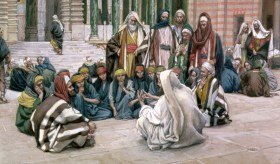
Jesus Speaks Near the Treasury, by James Tissot
So, why are the teachings given in such a way that’s confusing; in parables? What’s the point? In this age of immediate gratification, where information is available, literally at your fingertips, thanks to the iPhone, doesn’t this parable-approach risk losing the audience?
How are we supposed to interpret these parables? Even when we do, how do we know if we got it RIGHT? Isn’t that the goal, after all, to be RIGHT! To have THE ANSWER to how God works and what God wants from us? Just tell me plainly what I must do, and then I can decide if I’m willing to or not. Opt-in or opt-out. Just give me the facts, please!! Read the rest of this entry »
Abide and Thrive
May 10, 2015
Christ Church Episcopal, Norcross, GA
The 6th Sunday of Easter
Acts 10:44-48; 1 John 5:1-6; John 15:9-17
(Gospel text is provided at the bottom of this post)
During the first few Sundays of Easter we heard stories of encounters with the resurrected Jesus – outside the empty tomb; on the road to Emmaus; and in the upper room. Now, like a television show that gives us a “flashback scene” we’ve gone back in time, before the arrest and crucifixion. We’re getting a glimpse into what Jesus might have said to the disciples just before he was going to leave them. It’s a different picture of Jesus. Through these private conversations, we see a pastoral, caring and supportive Jesus – much different than the image of Jesus during his public ministry.
In his public ministry in John’s gospel, we have a Jesus that is compelling people to a new way of being. He’s turning over the tables in the temples to get them to re-claim their purpose; daring to break down barriers by talking with outsiders, like the Samaritan woman; exhibiting the spirit of God’s command of love for others by healing the blind man, even if it breaks the rules of tradition that tells them they can’t work on the Sabbath.
But now, we find Jesus secluded with his disciples; his inner circle. He knows what’s about to happen. He shifts from being their teacher, preacher and prophet, and is now focused on being their pastor. One of the last acts as a teacher was conveying the importance of servanthood. And now, as Jesus knows what lies ahead, he’s serves them even more, by preparing them for what’s coming next.
 jodygreenwood