With Arms Wide Open
December 20, 2015
Christ Church Episcopal, Norcross, GA
The 4th Sunday in Advent
Micah 5:2-5a; Hebrews 10:5-10; Luke 1:39-55
(Gospel text is provided at the bottom of this post)
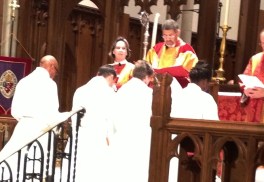 Three years ago I preached on this same passage from Luke’s gospel. I had just been ordained to the Transitional Diaconate a week earlier, and was back in Houston for Christmas break. I had been invited to serve as Deacon – for the first time – at St. Andrew’s, the parish that helped me on my vocational journey. I was a bit nervous and also thrilled to finally be doing what God had called me to do.
That day three years ago had begun three years before that. That’s when I made the decision to leave all that was familiar; to leave mother and father, brother and sisters and the rest of my family and friends. I left places of comfort, including the parish of St. Andrews, to embark on a new thing, in an unfamiliar place, where “what’s next” couldn’t be fully grasped.

St. Andrew’s Episcopal
So, to return to a familiar place after being ordained, surrounded by loved ones, those who supported me from afar, and to serve at that familiar altar – it was pretty surreal. I’m guessing Gretchen has some of these same feelings today, and I’m excited to see what the future holds for her.
Being Opened by a Merciful God
September 6, 2015
Christ Church Episcopal, Norcross, GA
The 15th Sunday after Pentecost; Proper 18
Proverbs 22:1-2, 8-9, 22-23; James 2:10-17; Mark 7:24-37
(Gospel text is provided at the bottom of this post)
When I was a young girl, probably in 6th or 7th grade, I wanted to be an acolyte at my church. Unfortunately our church didn’t let girls be acolytes. It wasn’t a matter of church policy, just that the man who trained the acolytes said that he’d only let boys be acolytes. He wouldn’t train girls, so they weren’t allowed.
 I’m not sure why he set this boundary – whether he had a deeply held theological conviction about gender roles in the church; or maybe he just found it easier to work with boys – maybe girls required a different teaching style; perhaps he thought girls weren’t up to the task of lighting candles, or carrying crosses and flags and such; or maybe it was just the way it was when he was growing up, so he wanted it to stay that way. I really don’t know why he held fast to this boundary – that only boys could be acolytes – I just knew that he was in charge, he set the rules, and no one was asking him to let girls in.
Then, one day, I’m not sure how it happened, a few of us girls told our Youth Minister, Steve, that we wanted to be acolytes. He was pretty new to the church, and didn’t see any problem with it, so he trained us. While we still couldn’t acolyte on Sunday morning, we could come to either of the two weekday Eucharist services and acolyte there. This meant waking up very early on Wednesday mornings during the summer so we could help at the 7am Eucharist. That’s how determined we were.
Do you not care?
June 21, 2015
Christ Church Episcopal, Norcross, GA
The 4th Sunday after Pentecost; Proper 7
Samuel 17:32-49; 2 Corinthians 6:1-13; Mark 4:35-41
Last week was Sandwich Sunday, so after the 8:00 am service, a bunch of folks gathered in the Parish Hall with loaves of bread, peanut butter & jelly and ham & cheese ready to get to work. As usual, there was the obligatory search for the plastic gloves… my Achilles heel. We had enough to get everyone started, but I decided I’d run up to Target and get a full box and some more bread.
As I was headed back to church I sat at the traffic light and thought to myself, “I love this job.” In my twenty years in banking I know there were times when I liked what I was doing, and certainly who I was working with. I know I was good at my job, but I’m not sure I could ever truthfully say “I love this job.”
I continued to hold onto that feeling of love for this job as the new work-week began. On Monday, I popped in on Mary and her team of helpers at the Norcross Co-op Vacation Bible School. Then headed over to the church with Rita and Ken to map out the new Four-square and Basketball design on the back parking lot. The love continued as I made final adjustments to the Celtic liturgy, not to mention the fun of the Vestry meeting on Monday night!
On Tuesday, my love continued in the midst of conversations about an updated sound system planned for the sanctuary, followed by productive staff and warden’s meetings. And these feeling of love carried over to Wednesday, even as I hauled water hoses under the blazing sun to get things ready for a Wild & Wacky night with the kids.
I went to bed Wednesday night weary from a physically challenging day – earning over 13,000 steps for my effort – and the payoff was an evening filled with smiling kids and teens pelting each other with water balloons and careening across a three-lane slip and slide. I mean, what’s NOT to love about this job! Read the rest of this entry »
Re-Turning to Purpose: We Shall Not Murder
March 8, 2015
Christ Church Episcopal, Norcross, GA
The 3rd Sunday in Lent
Exodus 20:1-17; 1 Corinthians 1:18-25; John 2:13-22
When we hear this story about Jesus turning over the tables and driving the livestock out of the temple grounds, we often use this as an example of Jesus’ HUMAN nature, as opposed to his DIVINE nature. There’s something comforting when we see this other side of Jesus; a Jesus who gets mad and starts throwing things. THIS is a Jesus we can relate to!
But I contend something very different is happening in today’s story.
First off, today’s reading comes from John’s gospel, which handles this event differently than the other gospels. In Matthew, Mark and Luke, the cleansing of the temple, as it is often called, happens near the end of Jesus’ ministry. He’s entered Jerusalem for the Passover and goes to the temple. But, in these gospels, the charge that accompanies the table-flipping is that the temple has become a den of thieves. And, it is this act in the temple that becomes the catalyst for his arrest and execution.
But that isn’t how John tells it.
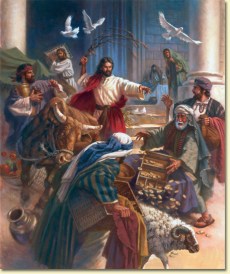
In John’s gospel, the table-turning is at the very beginning of Jesus’ ministry. Jesus has just left Cana and the infamous wedding where water has been changed into wine. Like the other gospels, he’s in Jerusalem for the Passover, but his actions in the temple grounds came not with an accusation of robbery, but instead carry an indictment that the Temple’s purpose has been usurped. They have turned a house of prayer into a marketplace. The temple had become a place of other things, and has lost its primary purpose – a place to meet God; to be connected with God.

