Let’s Grow
February 28, 2016
Christ Church Episcopal, Norcross, GA
3rd Sunday in Lent
Exodus 3:1-15; 1 Corinthians 10:1-13; Luke 13:1-9
 Today we heard the familiar story of Moses and the burning bush. The burning bush has become the quintessential symbol of God’s call to do God’s work in the world. In the story, we’re told that Moses is tending the flock of his father-in-law, Jethro. He’s just doing an ordinary thing on an ordinary day. He’s taken the flock beyond the wilderness and finds himself at Horeb, the mountain of God. Then Moses sees something that catches his eye… a bush on fire, yet not being consumed. And what does Moses do?
He doesn’t run away. He doesn’t ignore it and return to his flock. Instead, he says “I must turn aside and look at this great sight…” Moses TURNS and takes a closer look.
[Quick Sidebar: Remember that the root of the word repentance is μετανοέω (metanoeó) – to change direction, to TURN toward God. We are in the season of Lent, so the theme of repentance, of turning toward God, is everywhere! Even in this burning bush story!]
Preparing to Bloom
February 10, 2016
Christ Church Episcopal, Norcross, GA
Ash Wednesday
Isaiah 58:1-12; 2 Corinthians 5:20b-6:10; Matthew 6:1-6, 16-21
As many of you know, I lived in Houston, Texas most of my life. As with any city or town, Houston has its own unique rhythms, customs and colloquialisms that aren’t readily understood by outsiders. Not surprisingly, Atlanta and Georgia have their own, too, so when I moved here 6 years ago, I had a bit of a learning curve.
One of the things that I quickly discovered is that Liquor Stores are called Package Stores, but I didn’t know why. The name seemed so vague to me. So, one day I asked the guy behind the counter, “Why do they call this a Package Store, and not a Liquor Store?”  He explained that in Georgia, liquor laws differentiate sales based on whether it is bought by the drink (by the glass) or by the package (by the bottle). Thus, the Package Store.
Since then, I’ve shared this tid-bit of knowledge with others. For many, even life-long Georgians, this was a revelation. They had no clue where the term Package Store came from, and frankly, never even thought about it. And that’s okay. There’s no requirement to know. It doesn’t change anything, really.
But, in the same way, many of us who grew up in the church, certainly in the Episcopal tradition, have encountered and lived with words and practices that we don’t really know the context for, we just do them. Lent can be one of those times. Read the rest of this entry »
Do you not care?
June 21, 2015
Christ Church Episcopal, Norcross, GA
The 4th Sunday after Pentecost; Proper 7
Samuel 17:32-49; 2 Corinthians 6:1-13; Mark 4:35-41
Last week was Sandwich Sunday, so after the 8:00 am service, a bunch of folks gathered in the Parish Hall with loaves of bread, peanut butter & jelly and ham & cheese ready to get to work. As usual, there was the obligatory search for the plastic gloves… my Achilles heel. We had enough to get everyone started, but I decided I’d run up to Target and get a full box and some more bread.
As I was headed back to church I sat at the traffic light and thought to myself, “I love this job.” In my twenty years in banking I know there were times when I liked what I was doing, and certainly who I was working with. I know I was good at my job, but I’m not sure I could ever truthfully say “I love this job.”
I continued to hold onto that feeling of love for this job as the new work-week began. On Monday, I popped in on Mary and her team of helpers at the Norcross Co-op Vacation Bible School. Then headed over to the church with Rita and Ken to map out the new Four-square and Basketball design on the back parking lot. The love continued as I made final adjustments to the Celtic liturgy, not to mention the fun of the Vestry meeting on Monday night!
On Tuesday, my love continued in the midst of conversations about an updated sound system planned for the sanctuary, followed by productive staff and warden’s meetings. And these feeling of love carried over to Wednesday, even as I hauled water hoses under the blazing sun to get things ready for a Wild & Wacky night with the kids.
I went to bed Wednesday night weary from a physically challenging day – earning over 13,000 steps for my effort – and the payoff was an evening filled with smiling kids and teens pelting each other with water balloons and careening across a three-lane slip and slide. I mean, what’s NOT to love about this job! Read the rest of this entry »
Re-Turning to Purpose: We Shall Not Murder
March 8, 2015
Christ Church Episcopal, Norcross, GA
The 3rd Sunday in Lent
Exodus 20:1-17; 1 Corinthians 1:18-25; John 2:13-22
When we hear this story about Jesus turning over the tables and driving the livestock out of the temple grounds, we often use this as an example of Jesus’ HUMAN nature, as opposed to his DIVINE nature. There’s something comforting when we see this other side of Jesus; a Jesus who gets mad and starts throwing things. THIS is a Jesus we can relate to!
But I contend something very different is happening in today’s story.
First off, today’s reading comes from John’s gospel, which handles this event differently than the other gospels. In Matthew, Mark and Luke, the cleansing of the temple, as it is often called, happens near the end of Jesus’ ministry. He’s entered Jerusalem for the Passover and goes to the temple. But, in these gospels, the charge that accompanies the table-flipping is that the temple has become a den of thieves. And, it is this act in the temple that becomes the catalyst for his arrest and execution.
But that isn’t how John tells it.
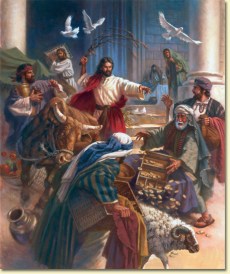
In John’s gospel, the table-turning is at the very beginning of Jesus’ ministry. Jesus has just left Cana and the infamous wedding where water has been changed into wine. Like the other gospels, he’s in Jerusalem for the Passover, but his actions in the temple grounds came not with an accusation of robbery, but instead carry an indictment that the Temple’s purpose has been usurped. They have turned a house of prayer into a marketplace. The temple had become a place of other things, and has lost its primary purpose – a place to meet God; to be connected with God.
 jodygreenwood