A Questioning Authority
October 1, 2017
Church of the Servant, Wilmington, NC
Proper 21, Year A
Ezekiel 18:1-4,25-32; Philippians 2:1-13; Matthew 21:23-32
Listen here, or read below:
Today’s gospel reading begins with Jesus in the temple. The chief priests and the elders came to him and asked, “By what authority are you doing these things, and who gave you this authority?” Before we dive into that riveting question, let’s step back a minute.
Last we saw Jesus, he was on the road to Jerusalem, using parables to teach about the kingdom of heaven. Yet here we are today, with Jesus in Jerusalem teaching in the temple. Our lectionary has jumped over an important piece of the story. And it skipped a couple of our favorite scenes. We missed the Palm Sunday entrance into Jerusalem – disciples untying the donkey, the crowd waving branches and crying Hosannas as Jesus rides in. And then, even better, overturning the tables in the temple market. Jesus gets mad – we love that part!
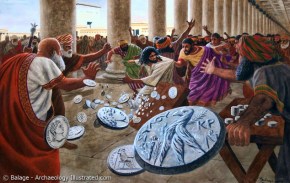
Then it goes on to say, “The blind and the lame came to him in the temple, and he cured them.” (Mt 21:14). And he begins teaching and the people are crying out, in the temple, “Hosanna to the son of David.”
The chief priests and scribes – those who are the ones in authority in the temple – see all this and wonder what the heck is going on. They’re angry and ask Jesus what he has to say for himself. And Jesus responds by quoting words of the prophets of old. “My house should be called a house of prayer” and “Out of the mouths of infants and nursing babies you have prepared praise for yourself.” And, as if that settles it, we’re told “He left them, went out of the city to Bethany, and spent the night there.” Read the rest of this entry »
Bearing Fruit
July 23, 2017
Christ Church Episcopal, Norcross, GA
Proper 11 Year A
Genesis 28:10-19a; Romans 8:12-25; Matthew 13:24-30,36-43
Listen here:
Gospel Text:
Jesus put before the crowd another parable: “The kingdom of heaven may be compared to someone who sowed good seed in his field; but while everybody was asleep, an enemy came and sowed weeds among the wheat, and then went away. So when the plants came up and bore grain, then the weeds appeared as well. And the slaves of the householder came and said to him, ‘Master, did you not sow good seed in your field? Where, then, did these weeds come from?’ He answered, ‘An enemy has done this.’ The slaves said to him, ‘Then do you want us to go and gather them?’ But he replied, ‘No; for in gathering the weeds you would uproot the wheat along with them. Let both of them grow together until the harvest; and at harvest time I will tell the reapers, Collect the weeds first and bind them in bundles to be burned, but gather the wheat into my barn.’”
Then he left the crowds and went into the house. And his disciples approached him, saying, “Explain to us the parable of the weeds of the field.” He answered, “The one who sows the good seed is the Son of Man; the field is the world, and the good seed are the children of the kingdom; the weeds are the children of the evil one, and the enemy who sowed them is the devil; the harvest is the end of the age, and the reapers are angels. Just as the weeds are collected and burned up with fire, so will it be at the end of the age. The Son of Man will send his angels, and they will collect out of his kingdom all causes of sin and all evildoers, and they will throw them into the furnace of fire, where there will be weeping and gnashing of teeth. Then the righteous will shine like the sun in the kingdom of their Father. Let anyone with ears listen!” (Mt 13:24-30, 36-43)
Celebrating Saints
November 6, 2016
Christ Church Episcopal, Norcross, GA
All Saints’ Day (transferred) – Year C
Daniel 7:1-3,15-18; Ephesians 1:11-23; Luke 6:20-31
(Gospel Text provided below)
I was lucky to get to know both of my Grandmothers as I was growing up. Both lived in Houston, both had ancestors who fought in the Revolutionary War, and both were named Mary. That may be where their similarities end.
My Grandmother Greenwood was from Lancaster, Pennsylvania. She moved to Houston after marrying my grandfather, who became a prominent neurosurgeon. The entry room of their grand two-story house was adorned with framed cross-stitch samplers made by the very daughters of those early colonial soldiers. She also had a Union Army uniform worn by her grandfather in the Civil War, along with three sabers and musket from that era. She was a collector of history and family heirlooms. She was an active member of the Daughters of the American Revolution, she always had a “Go Navy” bumper sticker on her car, and in addition to raising six children, she was active in the Episcopal church and volunteered for the Red Cross, among other things.
 Each Sunday after church we’d go to Grandma Greenwood’s house in our Sunday finest. We’d scamper upstairs to play games with our many cousins and if we were lucky, we’d be picked to help Grandpa wind the grandfather clock in the living room. When the food was ready, Grandma would call us to dinner, and we’d flock to the kitchen and take our places at the kid’s table. All my aunts and uncles gathered ‘round the large dining room table for a proper Sunday dinner, where white rice and sweet corn accompanied every meal, and Blue Bell ice cream brought it to an oh-so-sweet close. Read the rest of this entry »
Prayer: Back to the Basics
July 24, 2016
Christ Church Episcopal, Norcross, GA
10th Sunday After Pentecost – Proper 12
Luke 11:1-13
(Gospel Text provided below)
Today I’ll be sharing the pulpit with a couple folks who will be talking about Stewardship of Relationship. One is a member of Daughters of the King and the other is in the Order of St. Luke – both are prayer ministries at Christ Church. I don’t think the date was chosen based on the lectionary, so the fact that we’ve been provided with the quintessential gospel text for prayer gives some extra creds to the Holy Spirit!
And while prayer is certainly a way that we can be stewards of relationships with one another, it’s also a good way to be stewards of our relationship with God.
So with that in mind, what does this passage from Luke’s gospel tell us about prayer?
Prayer, in its simplest definition, is a way of connecting with God. Yet interestingly, the passage points out that it’s not instinctive. Prayer is actually a learned behavior. Even the disciples, these learners that are following Jesus, ask to be taught how to pray.

 jodygreenwood