Transforming Bread for All People
August 23, 2015
Christ Church Episcopal, Norcross, GA
The 13th Sunday after Pentecost; Proper 16
1 Kings 8:22-30, 41-43; Ephesians 6:10-20; John 6:56-69
(Gospel text is provided at the bottom of this post)
I always know the school year has started when I see clusters of parents walking their young children to school. I grew up in a time when parents rarely walked their kids to school. We’d jump on our bikes and head off on our own. Even so, there were rules we were expected to follow to keep us safe along the way.
 I remember one time, my younger sister, Virginia, was later than usual getting home from school, and Mom was getting worried. When my sister finally made it home, amid the relief, my mom asked her why it took so long. It turns out that when Virginia came to a busy intersection on her way home, she remembered the rule my parents taught her – to not cross the street until there weren’t any cars. While that’s a good rule, it doesn’t always work so well. If memory serves, the next lesson Virginia learned was about how to use the Walk/Don’t Walk signs at busy intersections!
Rules are important. For children, they can help set boundaries and keep them safe. Yet, as we grow older, we begin to use our own judgment; perhaps test the boundaries of the rules. And, as our context changes, like standing at a busy intersection, some rules need to be replaced with a new way forward.
John’s gospel shows us Jesus as the one who provides this new way; he’s all about transformation from what WAS to what’s NEXT! Read the rest of this entry »
On Purpose
July 12, 2015
Christ Church Episcopal, Norcross, GA
The 7th Sunday after Pentecost; Proper 10
2 Samuel 6:1-5, 12b-19; Ephesians 1:3-14; Mark 6:14-29
(Gospel text is provided at the bottom of this post)
If you were here last Sunday, you heard me make the case that Mark’s Gospel is the Action/Adventure movie of the New Testament. But, if we look at today’s passage, it seems more like a horror film. If I were watching this in the theater, this would be the time I’d go get a refill on my popcorn.
When we have a gospel reading like this it’s tempting to turn to the Old Testament or Epistle lesson for a good word, and avoid this gruesome tale altogether. And, as tempting as that was for me, I kept being pulled back to this text. So, let’s stick with Mark’s gospel and see if we can figure out what’s going on here.
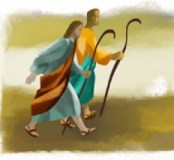 The reading today comes immediately after last week’s lesson… the one where the disciples have been empowered by Jesus and given authority to go and do God’s work. They have gone out two by two, with only a staff in hand and sandals on their feet. They were told to take no food, no money, no extra clothes – just GO, just as they were. They were proclaiming that all should repent. They were casting out demons. They were anointing the sick with oil and curing them. Pretty powerful stuff!
Then, all of the sudden, we’re presented with this odd and terribly graphic story about Herod and the beheading of John the Baptist. Read the rest of this entry »
The Gift of the Holy Spirit
May 24, 2015
Christ Church Episcopal, Norcross, GA
The Day of Pentecost
Acts 2:1-21; Romans 8:22-27; John 15:26-27, 16:4b-15
(Gospel text is provided at the bottom of this post)
Three years ago, as part of my seminary education, I was an intern chaplain at Grady Hospital. This Clinical Pastoral Education, as it’s called, or CPE, is a time to see what it’s like to be a hospital chaplain, and also a time to learn more about yourself, as a pastoral care giver.
 The various floors and departments of the hospital are divvied up to the six chaplain interns, and my parish, if you will, was a couple of the surgical floors. Now, patients on surgical floors aren’t usually there for a long time. They’re given a room after surgery and stay just long enough to be ready to go home, or go to another rehab facility.
 So, as a chaplain on a surgical floor, I made a lot of cold-calls, popping in, introducing myself as a chaplain, and seeing if the patient or their family wanted to talk or pray. My hope for my ministry was to be one person from the hospital team that interacted with the patient without poking or prodding them. I wanted to be a presence for them in whatever way might helpful.
Sometimes my invitation was well received and other times, not so much. But, that’s the way it goes.
I remember one day in particular, near the beginning of the summer. The resident chaplain suggested I visit a patient who had actually been there for several weeks. I’ll call the patient Bill.
I learned from the other chaplain that Bill and his girlfriend had been riding together on Bill’s motorcycle. They were riding through Atlanta on their way back to New York after a vacation in Florida. They had a wreck and Bill’s hip was badly injured and his girlfriend – I’ll call her Sue – had extensive injuries including brain trauma. She was in the intensive care unit (ICU), and although Sue was still alive, after several weeks she still hadn’t regained consciousness.
They were in an unfamiliar city with family far away; in different rooms and on different floors of the hospital. Read the rest of this entry »
Seeing deeply
February 11, 2015
Candler School of Theology – Episcopal Studies Eucharist Service
Holy Women, Holy Men: Fanny Crosby, Hymnwriter, February 11
Isaiah 42:10-12; 1 Peter 1:3-9; John 9:35-39
Last week when I was on campus, Bishop Whitmore asked if I could come and lead worship here today. He said that y’all are using Holy Women, Holy Men and then simply said “Fanny Crosby, “Blessed Assurance.” I admitted to him that I don’t know much about hymnody, but he smiled and said, “Just look at the gospel, that’s all you need to focus on.” So, it was a go!
As I looked at the texts for the service, I noticed that the reading from John was the end of the healing of the man born blind. Then, the Old Testament also mentioned leading the blind out of darkness. And it hit me, oh yeah, Fanny Crosby was blind!
Yet, unlike the man in the gospel story, Fanny wasn’t born blind. But when she was only six weeks old, she had an infection. It was 1820, so medicine was quite different then. The local doctor couldn’t be found, but a stranger said he could help, it’s unclear whether he was a real doctor or not. He put hot poultices on Fanny’s eyes to kill the infection. It must have been excruciating. The good news is that the infection cleared up, but the scars on her eyes rendered her sightless for the rest of her life.
Fanny’s father died within a year, and her mother became a maid. Fanny’s Grandmother was her primary caretaker. A woman of strong faith, she was determined to raise Fanny just as any child. She believed that all children come into the world ready to learn, and Fanny’s grandmother taught her plenty![i] Read the rest of this entry »
 jodygreenwood