Happy Tail-wagging Day!
November 26, 2015
Christ Church Episcopal, Norcross, GA
Thanksgiving Day; Year B
Joel 2:21-27; Psalm 126; 1 Timothy 2:1-7; Matthew 6:25-33
A few days ago I saw a post on my Facebook Page that caught my eye. This is what it said:
There is a story they tell of two dogs.
Both at separate times walk into the same room.
One comes out wagging his tail while the other comes out growling.
A woman watching this goes into the room to see what could possibly make one dog so happy and the other so mad.
To her surprise she finds a room filled with mirrors.
The happy dog found a thousand happy dogs looking back at him while the angry dog saw only angry dogs growling back at him.
What you see in the world around you is a reflection of who you are.

I think there’s a lot of truth to this.
Just yesterday, as I was trying to make my way through a grocery store parking lot, I found myself getting more and more frustrated. At 3:00 pm on the day before Thanksgiving, everyone is getting their last-minute items – including me. I was already envisioning the long check-out lines and decided I just didn’t have the patience for this right now, so I headed to another store, one closer to home.
Luckily, that extra drive gave me a chance to make an attitude adjustment. Read the rest of this entry »
The Tenacity of HOPE; The Discipline of LOVE
November 15, 2015
Christ Church Episcopal, Norcross, GA
The 25th Sunday after Pentecost; Proper 28
1 Samuel 1:4-20; Hebrews 10:11-25; Mark 13:1-8
(Gospel text is provided at the bottom of this post)
You may have heard me refer to Mark’s gospel as the “action adventure movie” of the New Testament. Jesus is constantly on the move, going from town to town. Folks gather ’round wherever he is and he heals them and casts out demons. Even when he tries to get off for some time to himself, they find him – his compassion compels him to respond to their needs.
But today, we’ve reached the part of Mark’s gospel that sounds more like Mad Max, Independence Day and Armageddon all rolled into one!
It all starts innocently enough. Up until now, Jesus and the disciples have been traveling around Galilee, in small towns and the countryside. They’ve now entered Jerusalem and Jesus has been teaching in the temple.
 As they leave the temple, the disciples marvel at the large buildings all around them – the grandness and permanence of this holy place. The place where the Hebrew people make pilgrimage for great feast days. The temple that held God’s presence.
But, as Jesus hears the disciples’ wonderment, instead of marveling along with them Jesus turns and informs them, “Do you see these great buildings? Not one stone will be left here upon another; all will be thrown down.”
When the disciples ask for details, the message gets even more grim: Read the rest of this entry »
Acts of Surrender
October 25, 2015
Christ Church Episcopal, Norcross, GA
The 22nd Sunday after Pentecost; Proper 25
Job 42:1-6, 10-17; Hebrews 7:23-28; Mark 10:46-52
(Gospel text is provided at the bottom of this post)
Surrender.
Tammy Pallot used that word as she shared her stewardship journey with us a couple of weeks ago. She described stewardship, ultimately, as an act of surrender.
 A few days later at the Wednesday Healing Eucharist, the word surrender emerged again. When looking at the previous Sunday’s gospel text, someone characterized Jesus’ instruction to the rich man – to sell all his possessions and give the money to the poor – that is, to leave everything and follow Jesus, as an act of surrender.
And, a few days later, at a continuing education conference, the word surrender came up again, when I came face to face with Centering Prayer. You see, when I enrolled in the conference, it was the topic that drew me in, and I hadn’t grasped that it would be not only a silent retreat, but also filled with several hours of centering prayer each day.
For those unfamiliar with centering prayer, as I was until last weekend, you sit in silence and in stillness for a designated amount of time – usually at least 20 minutes, but it can be more. And, in that silent stillness, you consent to God’s presence and action within you. Certainly an act of surrender.
As I reflect on today’s gospel lesson, I see several acts of surrender, as well.
First, it begins by telling us that Jesus and his disciples entered Jericho. Then, the very next sentence talks about them LEAVING Jericho, but now, there is a large crowd with them. We aren’t told what happened in Jericho – perhaps the original “what happens in Jericho, stays in Jericho” – but we know that SOMETHING happened, because people have surrendered their normal life – have left their homes – and are now following Jesus!
Next, as Jesus is walking along the road with this crowd of people, my guess is that he’s continuing to teach and share his Jesus-ness with them! Then all of the sudden, this blind man named Bartimaeus is on the side of the road and begins crying out,
“Jesus, Son of David, have mercy on me!” Many sternly ordered him to be quiet, but he cried out even more loudly, “Son of David, have mercy on me!”
 Now, Jesus could’ve kept on with his teaching; kept walking and never looked back. But, he had just admonished James and John for being all about the power and glory. Jesus had just said that “the Son of Man came not to be served but to serve, and to give his life a ransom for many.” (Mk 10:45) So, instead of going about his own plan for the day, Jesus surrendered. It says “Jesus stood still” – he stopped in his tracks and had them call Bartimaeus over to him.
And then it says “throwing off his cloak, [Bartimaeus] sprang up and came to Jesus.” You can sense his exuberance as he approached Jesus – thrilled to be noticed – someone who has been an outcast and beggar.
But, Jesus doesn’t just assume that he knows what the blind man wants, but instead asks him “What do you want me to do for you?” And Bartimaeus asks to get his eyesight back. While this may seem like a foregone conclusion to us, I wouldn’t be so sure.
This man has been blind for some time, we don’t know how long. He has found a way in life that seems to work, even though it may not be ideal. His basic needs are being taken care of, and no one is expecting too much from him. When his sight is restored, that will change. He will be transformed, not only physically, but society will perceive him differently. What’s more, his understanding of God will be transformed, too, and with it comes an acknowledgement of God’s generosity and mercy in his life.
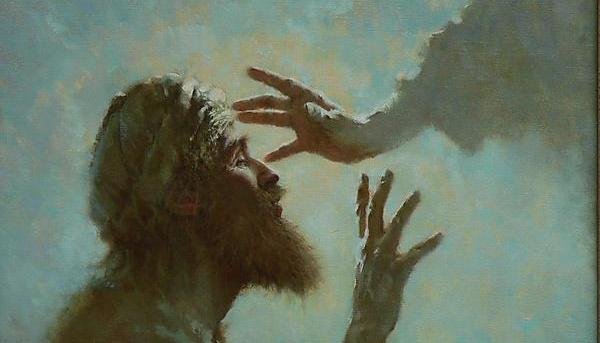 So, in responding to Jesus, Bartimaeus makes a choice to surrender to God:
The blind man said to him, “My teacher, let me see again.” Jesus said to him, “Go; your faith has made you well.” Immediately he regained his sight and followed him on the way.
The proof that this transformation was not just physical, is that Jesus says “Go” yet Bartimaeus, having surrendered himself fully, remained with Jesus – and followed him on the way. Having received the gift of sight, and with it, a transformed life, Bartimaeus surrendered that life to God.
I invite you this morning to think about where you find yourself in this story.
- Are you like one of those in the large crowd that has been touched by the word of God, and surrendered everything to follow Jesus?
- Or, are you consumed by the busy-ness of life; trying to keep everything together; struggling to find a way to simply stand still long enough to feel Jesus’ presence?
- Perhaps you are one crying out for Jesus to have mercy on you? If so, consider how you might answer his question “What do you want me to do for you?” Also rest in the assurance that God’s love and mercy is with you.
- Or, have you felt the power and love of Jesus in your life, like Bartimaeus did – and with renewed sight and a transformed life, chosen to freely give back to God?
We each may find ourselves in different places of this story at different times and circumstances in our life.  We are all on a journey that takes twists and turns, and we can find comfort in knowing that God is with us along the way.
I believe that part of our journey is the act of surrender to self by seeking God’s will for our lives, and in doing this, to give of ourselves – our time, talent and treasure – to God’s work in the world.
So, I ask you today, to surrender.
Gospel Text:
Jesus and his disciples came to Jericho. As he and his disciples and a large crowd were leaving Jericho, Bartimaeus son of Timaeus, a blind beggar, was sitting by the roadside. When he heard that it was Jesus of Nazareth, he began to shout out and say, “Jesus, Son of David, have mercy on me!” Many sternly ordered him to be quiet, but he cried out even more loudly, “Son of David, have mercy on me!” Jesus stood still and said, “Call him here.” And they called the blind man, saying to him, “Take heart; get up, he is calling you.” So throwing off his cloak, he sprang up and came to Jesus. Then Jesus said to him, “What do you want me to do for you?” The blind man said to him, “My teacher, let me see again.” Jesus said to him, “Go; your faith has made you well.” Immediately he regained his sight and followed him on the way. (Mark 10:46-52)
The Future for Jesus
September 20, 2015
Christ Church Episcopal, Norcross, GA
The 17th Sunday after Pentecost; Proper 20
Proverbs 31:10-31; James 3:13-4:3, 7-8; Mark 9:30-37
(Gospel text is provided at the bottom of this post)
 This past Friday I spent the morning at All Saints, in Atlanta. Bishop Andy Doyle was there – he’s the bishop from my home diocese in Texas. He was talking about his new book: Church: A Generous Community Amplified for the Future.
Pointing to the future, he shared a couple of videos. These videos included images like self-driving cars, and 3-D printers that not only create parts for cars, but implantable organs for our bodies.  We saw integrated technologies that anticipate our every need, and a tube-passenger train that gets us from Los Angeles to San Francisco in 30 minutes. Some of these futuristic imaginings are already underway, while others are only in their early stages – but all could be viable in the next fifty years.
 Bishop Doyle pointed out that the business world thinks a lot about the future. It looks at current trends and considers shifts in cultural behavior. From there, it explores the possibilities of what is needed to meet future needs, and then begins to lead society in a direction of what the next reality will look like for us.
In our time together, Bishop Doyle challenged us, as clergy, to do some of this same kind of future-looking work in the church. He pointed out that the church isn’t historically good at this kind of future-looking work, which is probably true. But, I don’t think this is unique to our generation. I don’t even think it’s unique to Christianity. We get a sense of how difficult making shifts to new things can be, even 2000 years ago, when Jesus came to start a new thing. Read the rest of this entry »

