Revealing the Empty Tomb
April 4, 2015
Christ Church Episcopal, Norcross, GA
The Great Vigil of Easter
Romans 6:3-11; Mark 16:1-8
(Gospel text is provided at the bottom of this post)
In the course of this evening, we’ve moved from the darkness of night – holding the painful, confusing crucifixion of Jesus on the cross – to the bursting-in of light – rejoicing and celebrating the glorious resurrection of Jesus Christ anew!
We’ve heard our ancient stories retold: beginning again in darkness, until God’s “Let there be Light!” spoke creation into existence. We traversed the Red Sea alongside the Israelites. By God’s grace, our hearts of stone were made new, and we witnessed God’s generosity and power as dry bones were transformed to a new and reformed life!
And now we’ve extinguished our candles and in the bright light of Christ, we hear more good news! The tomb is empty! The crucified Christ is no longer confined by the cold stone walls of death! Alleluia, Christ is risen! The Lord is risen indeed, Alleluia!
In Mark’s gospel, we’re told that when Mary Magdalene, Mary the mother of James, and Salome – these three women – approach the tomb, they see that the stone has been rolled away. When they entered the tomb, they saw a young man dressed in all white. He told them that Jesus had been raised and was not there. He instructed them to go and tell Peter and the other disciples that they will find Jesus in Galilee.
But what comes next isn’t your usual resurrection story… unlike the other gospel writers, Mark ends his gospel saying: “So they went out and fled from the tomb, for terror and amazement had seized them; and they said nothing to anyone, for they were afraid.”
They said nothing to anyone.
Living on Purpose
March 22, 2015
Christ Church Episcopal, Norcross, GA
The 5th Sunday in Lent
Jeremiah 31:21-34; Hebrews 5:5-10; John 12:20-33
(Gospel text is provided at the bottom of this post)
 Is it just me, or does this gospel lesson feel a little awkward? It starts with some Greeks telling Philip that they want to see Jesus. Philip then goes and gets his friend and fellow-disciple Andrew. The two of them then go and tell Jesus that some Greeks want to see him. That seems normal enough, I guess.
But then, instead of Jesus saying, “Great! Where are they? Let’s talk!,” Jesus goes into this whole thing about the Son of God having to be glorified, and a grain of wheat having to die, and losing one’s life to keep it… it’s really quite confusing! What is the gospel writer doing with this story?
Well, not unlike the turning over of the tables we talked about a couple of weeks ago, I think John is using this passage to reveal Jesus’ full awareness of his purpose. Even more, I think this story shows us that Andrew and Philip also understood and lived into their purpose.
Re-Turning to Purpose: We Shall Not Murder
March 8, 2015
Christ Church Episcopal, Norcross, GA
The 3rd Sunday in Lent
Exodus 20:1-17; 1 Corinthians 1:18-25; John 2:13-22
When we hear this story about Jesus turning over the tables and driving the livestock out of the temple grounds, we often use this as an example of Jesus’ HUMAN nature, as opposed to his DIVINE nature. There’s something comforting when we see this other side of Jesus; a Jesus who gets mad and starts throwing things. THIS is a Jesus we can relate to!
But I contend something very different is happening in today’s story.
First off, today’s reading comes from John’s gospel, which handles this event differently than the other gospels. In Matthew, Mark and Luke, the cleansing of the temple, as it is often called, happens near the end of Jesus’ ministry. He’s entered Jerusalem for the Passover and goes to the temple. But, in these gospels, the charge that accompanies the table-flipping is that the temple has become a den of thieves. And, it is this act in the temple that becomes the catalyst for his arrest and execution.
But that isn’t how John tells it.
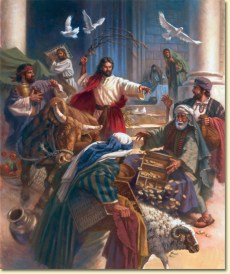
In John’s gospel, the table-turning is at the very beginning of Jesus’ ministry. Jesus has just left Cana and the infamous wedding where water has been changed into wine. Like the other gospels, he’s in Jerusalem for the Passover, but his actions in the temple grounds came not with an accusation of robbery, but instead carry an indictment that the Temple’s purpose has been usurped. They have turned a house of prayer into a marketplace. The temple had become a place of other things, and has lost its primary purpose – a place to meet God; to be connected with God.
What the Promise is For
February 22, 2015
Christ Church Episcopal, Norcross, GA
The 1st Sunday in Lent
Genesis 9:8-17; 1 Peter 3:18-22; Mark 1:9-15
Today’s Old Testament lesson is the very end of the story of Noah and the ark. Y’all remember Noah – he was a righteous person, chosen by God to build an ark. And, in spite of the ridicule he surely received from those around him, he built a HUGE floating barn, and then gathered up all the species of animals, two-by-two, and loaded them into the ark.
He must’ve looked like a fool, but for him, he was being obedient to God, even if it didn’t make much sense – that’s what made him righteous. Then, you remember what happens next, it started to rain… and it rained, and rained… and NOW who looked foolish? Not Noah!
He and his family boarded the ark with all the animals and the story says that it rained for 40 days and 40 nights until water covered the whole earth; as far as they could see. After the rain stopped, they floated around awhile as the water receded and the ark was finally resting on solid ground. Noah, his family and the animals were once again on dry land, and when it was all over God made a promise: Read the rest of this entry »

