They’ll know… by Our Love
June 1, 2015
Christ Church Episcopal, Norcross, GA
This is an article written for the church’s monthly newsletter, the Communique, published in June, 2015.
In early May the J2A Pilgrims (the 8th & 9th grade Youth Group) headed to Birmingham, Alabama for their Urban Adventure. The weekend’s purpose is to immerse the teens in an unfamiliar urban area and have them find their way to various locations, by foot and mass transit, without smartphones or internet assistance. It’s a weekend intended to prepare them for their Pilgrimage next summer when they’ll be in unfamiliar lands and work together to find their way.
To spice things up, the group is divided into two teams and they compete to get to all the locations and finish first. We added an Amazing Race component, so they had to gather a piece of information at each destination – like the number of birds in a specific statue. The adults are only there to make sure they don’t get into trouble, but not to help navigate, so the teams must work together and find their way together.
Before the trip, I decided to pick a song that could unite us. I thumbed through an old music book my mom had given me years ago and came across “They Will Know We are Christians by our Love.” It would be easy to teach, and I hoped it would temper the competition somewhat by reminding them that in the midst of a strange place, we’re setting an example of what it is to be Christian. In hindsight, it also connected with each phase of our weekend together – I call that the Holy Spirit!
Pursuing Your Purpose
January 6, 2015
Christ Church Episcopal, Norcross, GA
The Feast of Epiphany
Isaiah 60:1-6; Ephesians 3:1-12; Matthew 2:1-12
When I was a young girl I looked forward to the Epiphany service at my church each year. Like tonight, it began after the night sky had become dark. As we arrived, we were each given candles, cre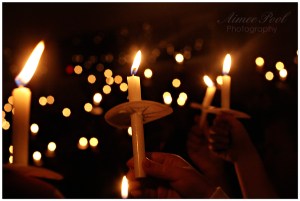 ating a dimly lit sanctuary. The opening hymn was “We Three Kings.” The congregation sang the first and last verse, and male soloists from the choir sang the middle verses. Each king sang their arrival, walking ever-so-slowly up the long-center aisle; each dressed in finery of a far-off-land; each carrying a gift brought for the God-child they had searched out. The smell of the frankincense filled the sanctuary – creating a full-on sensory experience.
For completely different reasons, this evening’s service, with bi-lingual scripture, prayers and music, is just as glorious; just as life-giving. This time tonight represents a manifestation of experiencing the beauty of a new born thing, worthy of The Epiphany! It is a time of letting go of what is common place, of the status quo, which isn’t always easy. Read the rest of this entry »
Still We Rise!
June 1, 2014
Christ Church Episcopal, Norcross, GA
7th Sunday of Easter – RCL Year A
Acts 1:6-14; 1 Peter 4:12-14, 5:6-11; John 17:1-11
 “Go confidently in the direction of your dreams! Live the life you’ve imagined.” This Henry David Thoreau quote confronts me each time I open the refrigerator door. It sits as a framed, limited edition work of art, created by my niece, Kayanne. The card arrived in my mailbox four years ago announcing that she would be graduating from college with a degree in Graphic Design.
Although I’ve never asked, I’d like to think that Kayanne’s connection with this quote may have been partially inspired by a time she and I spent together just four years earlier, at the time of her high school graduation. As a graduation present, I got tickets for Kayanne and me to hear Dr. Maya Angelou when she came to Houston. Angelou had been a favorite of my older sister, Kathy, Kayanne’s mom, who had died a couple of years earlier. So, sharing this experience with Kayanne was one way of bringing her mom into the celebration with us.
During the evening we were captivated by the inspiring and poignant words of Angelou. Her message was optimistic while she encouraged each of us to share our unique gifts with the world. She attributed each person’s unique strengths to their ability to rise above the struggles in life, and she assured us that “each of us has the power to change someone’s life,” saying, “Sometimes if you just speak to someone it can change their whole day.” (1) Read the rest of this entry »
The Gift of Connectedness
May 25, 2014
Christ Church Episcopal, Norcross, GA
6th Sunday of Easter – RCL Year A
Acts 17:22-31; 1 Peter 3:13-22 ; John 14:15-21
A few months ago, TJ, a member of the J2A Youth group, approached me after Sunday school to ask if I could help her with a school paper. She had to write her perspective on the Creation stories found in Genesis in light of the scientific evidence of Evolution. She assured me that outside resources were allowed, including priests, so I was happy to help.
When she called later that day, I shared with TJ how I have reconciled these two ways of seeing God’s Creation of the world and humanity. As a life-long Episcopalian, my formation has been under-girded by what is sometimes called the “three-legged stool” of Anglican Theology: Scripture, Tradition and Reason. So, as new knowledge is revealed, reason is used alongside Scripture, and plays a part in our understanding of God and God’s relationship to the world.
After sharing my perspective, TJ asked if I had any outside resources that might be helpful for additional evaluation. At first I couldn’t think of anything, but then, I remembered a Newsweek article I read in the late 80’s that intrigued me – it was called “The Search for Adam and Eve.” What’s more amazing is that I was pretty sure I had a copy of it, and after a few minutes digging through boxes in the garage, though a Google search would’ve been faster, I found it for her to use.
The article talked about a study conducted by microbiologists at Berkeley and Emory who were exploring the origin of the modern human race. The authors acknowledge the risk of using the biblical names of Adam and Eve in the title – but how else are you going to sell magazines, right? The opening paragraph says in part: Read the rest of this entry »

