Re-Turning to Purpose: We Shall Not Murder
March 8, 2015
Christ Church Episcopal, Norcross, GA
The 3rd Sunday in Lent
Exodus 20:1-17; 1 Corinthians 1:18-25; John 2:13-22
When we hear this story about Jesus turning over the tables and driving the livestock out of the temple grounds, we often use this as an example of Jesus’ HUMAN nature, as opposed to his DIVINE nature. There’s something comforting when we see this other side of Jesus; a Jesus who gets mad and starts throwing things. THIS is a Jesus we can relate to!
But I contend something very different is happening in today’s story.
First off, today’s reading comes from John’s gospel, which handles this event differently than the other gospels. In Matthew, Mark and Luke, the cleansing of the temple, as it is often called, happens near the end of Jesus’ ministry. He’s entered Jerusalem for the Passover and goes to the temple. But, in these gospels, the charge that accompanies the table-flipping is that the temple has become a den of thieves. And, it is this act in the temple that becomes the catalyst for his arrest and execution.
But that isn’t how John tells it.
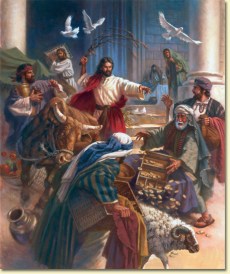
In John’s gospel, the table-turning is at the very beginning of Jesus’ ministry. Jesus has just left Cana and the infamous wedding where water has been changed into wine. Like the other gospels, he’s in Jerusalem for the Passover, but his actions in the temple grounds came not with an accusation of robbery, but instead carry an indictment that the Temple’s purpose has been usurped. They have turned a house of prayer into a marketplace. The temple had become a place of other things, and has lost its primary purpose – a place to meet God; to be connected with God.
Casting out OUR unclean spirits
February 1, 2015
Christ Church Episcopal, Norcross, GA
The 4th Sunday after Epiphany
Deuteronomy 18:15-20; 1 Corinthians 8:1-13; Mark 1:21-28
As many of you know, I spent much of my life in banking – mostly on the operations side. One of my roles was managing projects to improve the effectiveness and efficiency of our business – like making sure the car payment you sent in gets credited to your loan accurately, otherwise you’re gonna get a call from our collections department, and nobody wants that!
 A process improvement method we adopted was called Six Sigma, which is rooted in statistics – now, stay with me. It was initially used by the manufacturing sector. As you can imagine there are lots of places in an assembly-line production, especially complex ones, that can cause the end-product to be defective.
 “Six Sigma” is an actual calculated measure that corresponds to 1 in every 300,000. So, as a productivity measure, to reach 6-sigma, it means there is only one defect in 300,000 opportunities. It’s an ambitious goal to only have one defect in that many attempts, but for that person who waited in line overnight for the latest iPhone, or the one standing at the baggage claim carousel, but not seeing their suitcase arrive, it’s the kind of goal we want Apple or Delta to have. Read the rest of this entry »
The Gospel according to Huckleberry Finn
January 11, 2015
Christ Church Episcopal, Norcross, GA
The 1st Sunday after Epiphany
Genesis 1:1-5; Acts 19:1-7; Mark 1:4-11
 After the worship service on Christmas morning, Alice and I headed to Hilton Head for a few days of R&R. We stayed at a hotel with a beachfront view, and each morning as I awoke, I could see the thin glimmer of day breaking, as color peeked above the ocean waters. I was drawn to it. Each day I welcomed the gradual emergence of a new day; of God’s creation.
That first morning at the beach, I began reading The Adventures of Huckleberry Finn. You know Huck, he’s Tom Sawyer’s good friend; the one who traveled down the Mississippi River on a raft alongside a runaway slave named Jim. I’ve always loved Mark Twain’s humor and the way he captures the full picture of life, both glistening and gritty. Through his stories he brings to light the truth of real-life experiences. Read the rest of this entry »
What’s The WORD?
December 25, 2014
Christ Church Episcopal, Norcross, GA
Christmas III
Isaiah 52:7-10; Hebrews 1:1-4; John 1:1-14
John’s gospel account of Jesus coming into the world is powerful and poetic. It doesn’t tell of the birth of a child in a stable in a little town called Bethlehem, but instead, the opening words of John’s gospel bring to mind the creation story of Genesis, which begins:
In the beginning when God created the heavens and the earth, the earth was a formless void and darkness covered the face of the deep, while a wind from God swept over the face of the waters. Then God said, ‘Let there be light’; and there was light. And God saw that the light was good; and God separated the light from the darkness. God called the light Day, and the darkness he called Night. And there was evening and there was morning, the first day. (Gen 1:1-5, NRSV)
But, John’s gospel backs up even farther. It doesn’t begin with the creation of the heavens and the earth, but instead, with the nature of God. In light of the incarnate Jesus, God can no longer be understood in the same way God was understood before. After the life, death and resurrection of Jesus, there was a deeper understanding of the complexity of God – that this one-God whom the people of Israel followed is actually a three-in-one-God: the Father, the Son and the Holy Spirit.
Now, while this doesn’t seem too complicated to you and me, having heard of this Trinity God from the beginning of OUR religious context, this was pretty radical stuff a couple of thousand years ago; certainly for the people of Israel. One thing that set them apart from the gentiles was their devotion to ONE God, not may gods. Remember, the first commandment brought down by Moses from Mt. Sinai was:
I am the Lord your God, who brought you out of the land of Egypt, out of the house of slavery; you shall have no other gods besides me.” (Ex. 20:2-3)
So, then comes Jesus, and Houston, we have a problem! Read the rest of this entry »
 jodygreenwood