Being Opened by a Merciful God
September 6, 2015
Christ Church Episcopal, Norcross, GA
The 15th Sunday after Pentecost; Proper 18
Proverbs 22:1-2, 8-9, 22-23; James 2:10-17; Mark 7:24-37
(Gospel text is provided at the bottom of this post)
When I was a young girl, probably in 6th or 7th grade, I wanted to be an acolyte at my church. Unfortunately our church didn’t let girls be acolytes. It wasn’t a matter of church policy, just that the man who trained the acolytes said that he’d only let boys be acolytes. He wouldn’t train girls, so they weren’t allowed.
 I’m not sure why he set this boundary – whether he had a deeply held theological conviction about gender roles in the church; or maybe he just found it easier to work with boys – maybe girls required a different teaching style; perhaps he thought girls weren’t up to the task of lighting candles, or carrying crosses and flags and such; or maybe it was just the way it was when he was growing up, so he wanted it to stay that way. I really don’t know why he held fast to this boundary – that only boys could be acolytes – I just knew that he was in charge, he set the rules, and no one was asking him to let girls in.
Then, one day, I’m not sure how it happened, a few of us girls told our Youth Minister, Steve, that we wanted to be acolytes. He was pretty new to the church, and didn’t see any problem with it, so he trained us. While we still couldn’t acolyte on Sunday morning, we could come to either of the two weekday Eucharist services and acolyte there. This meant waking up very early on Wednesday mornings during the summer so we could help at the 7am Eucharist. That’s how determined we were.
Transforming Bread for All People
August 23, 2015
Christ Church Episcopal, Norcross, GA
The 13th Sunday after Pentecost; Proper 16
1 Kings 8:22-30, 41-43; Ephesians 6:10-20; John 6:56-69
(Gospel text is provided at the bottom of this post)
I always know the school year has started when I see clusters of parents walking their young children to school. I grew up in a time when parents rarely walked their kids to school. We’d jump on our bikes and head off on our own. Even so, there were rules we were expected to follow to keep us safe along the way.
 I remember one time, my younger sister, Virginia, was later than usual getting home from school, and Mom was getting worried. When my sister finally made it home, amid the relief, my mom asked her why it took so long. It turns out that when Virginia came to a busy intersection on her way home, she remembered the rule my parents taught her – to not cross the street until there weren’t any cars. While that’s a good rule, it doesn’t always work so well. If memory serves, the next lesson Virginia learned was about how to use the Walk/Don’t Walk signs at busy intersections!
Rules are important. For children, they can help set boundaries and keep them safe. Yet, as we grow older, we begin to use our own judgment; perhaps test the boundaries of the rules. And, as our context changes, like standing at a busy intersection, some rules need to be replaced with a new way forward.
John’s gospel shows us Jesus as the one who provides this new way; he’s all about transformation from what WAS to what’s NEXT! Read the rest of this entry »
Revealing the Empty Tomb
April 4, 2015
Christ Church Episcopal, Norcross, GA
The Great Vigil of Easter
Romans 6:3-11; Mark 16:1-8
(Gospel text is provided at the bottom of this post)
In the course of this evening, we’ve moved from the darkness of night – holding the painful, confusing crucifixion of Jesus on the cross – to the bursting-in of light – rejoicing and celebrating the glorious resurrection of Jesus Christ anew!
We’ve heard our ancient stories retold: beginning again in darkness, until God’s “Let there be Light!” spoke creation into existence. We traversed the Red Sea alongside the Israelites. By God’s grace, our hearts of stone were made new, and we witnessed God’s generosity and power as dry bones were transformed to a new and reformed life!
And now we’ve extinguished our candles and in the bright light of Christ, we hear more good news! The tomb is empty! The crucified Christ is no longer confined by the cold stone walls of death! Alleluia, Christ is risen! The Lord is risen indeed, Alleluia!
In Mark’s gospel, we’re told that when Mary Magdalene, Mary the mother of James, and Salome – these three women – approach the tomb, they see that the stone has been rolled away. When they entered the tomb, they saw a young man dressed in all white. He told them that Jesus had been raised and was not there. He instructed them to go and tell Peter and the other disciples that they will find Jesus in Galilee.
But what comes next isn’t your usual resurrection story… unlike the other gospel writers, Mark ends his gospel saying: “So they went out and fled from the tomb, for terror and amazement had seized them; and they said nothing to anyone, for they were afraid.”
They said nothing to anyone.
Re-Turning to Purpose: We Shall Not Murder
March 8, 2015
Christ Church Episcopal, Norcross, GA
The 3rd Sunday in Lent
Exodus 20:1-17; 1 Corinthians 1:18-25; John 2:13-22
When we hear this story about Jesus turning over the tables and driving the livestock out of the temple grounds, we often use this as an example of Jesus’ HUMAN nature, as opposed to his DIVINE nature. There’s something comforting when we see this other side of Jesus; a Jesus who gets mad and starts throwing things. THIS is a Jesus we can relate to!
But I contend something very different is happening in today’s story.
First off, today’s reading comes from John’s gospel, which handles this event differently than the other gospels. In Matthew, Mark and Luke, the cleansing of the temple, as it is often called, happens near the end of Jesus’ ministry. He’s entered Jerusalem for the Passover and goes to the temple. But, in these gospels, the charge that accompanies the table-flipping is that the temple has become a den of thieves. And, it is this act in the temple that becomes the catalyst for his arrest and execution.
But that isn’t how John tells it.
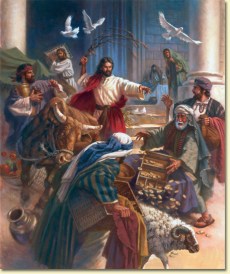
In John’s gospel, the table-turning is at the very beginning of Jesus’ ministry. Jesus has just left Cana and the infamous wedding where water has been changed into wine. Like the other gospels, he’s in Jerusalem for the Passover, but his actions in the temple grounds came not with an accusation of robbery, but instead carry an indictment that the Temple’s purpose has been usurped. They have turned a house of prayer into a marketplace. The temple had become a place of other things, and has lost its primary purpose – a place to meet God; to be connected with God.

