A New Commandment
April 24, 2016
Christ Church Episcopal, Norcross, GA
5th Sunday of Easter – 8:00 am service
Acts 11:1-18; Revelation 21:1-6; John 13:31-35
Earlier this month, on April 4th, I was listening to NPR as I was getting ready for my day. They were talking about this day being the anniversary of the assassination of Dr. Martin Luther King, Jr. Each year, as part of the retelling of that story, an excerpt from his final speech, given the night before, is always included.
The year was 1968 and King was in Memphis, Tennessee speaking on behalf of the sanitation workers, among other things. In his speech he shared that the flight out of Atlanta that morning had been delayed because, knowing that King would be on-board, they had taken extra security measures to ensure the plane and its contents hadn’t been tampered with. King had also heard of threats after arriving in Memphis. Yet, in his speech on April 3rd, he ended with these familiar words:

“Well, I don’t know what will happen now. We’ve got some difficult days ahead. But it really doesn’t matter with me now, because I’ve been to the mountaintop.
And I don’t mind.
Like anybody, I would like to live a long life. Longevity has its place. But I’m not concerned about that now. I just want to do God’s will. And He’s allowed me to go up to the mountain. And I’ve looked over. And I’ve seen the Promised Land. I may not get there with you. But I want you to know tonight, that we, as a people, will get to the promised land!
And so I’m happy, tonight.
I’m not worried about anything.
I’m not fearing any man!
Mine eyes have seen the glory of the coming of the Lord!!”[i]
This thing just got real
January 17, 2016
Christ Church Episcopal, Norcross, GA
2nd Sunday after Epiphany
Isaiah 62:1-5; 1 Corinthians 12:1-11; John 2:1-11
(Gospel text is provided at the bottom of this post)
When I was preparing for today’s sermon, I wondered why this miracle story is included as part of the Epiphany narrative. Now, I realize that it’s the first miracle presented in John’s gospel. It’s also a popular story about Jesus changing water into wine, so it’s got that going for it!  We like the idea that Jesus was the one who pulled-off this miracle so that the wedding celebration could continue… the ultimate party guest, providing more wine; even BETTER wine, for what would have been a multi-day festivity.
But there’s something very different going on here. This miracle is the act that propelled Jesus into the spotlight. This was the moment of broader revelation – the Epiphany moment – in John’s gospel. The brevity of the story-telling masks the magnitude of what has happened – perhaps not to its earliest audiences – but certainly to us today.
The story begins by telling us that Jesus and his disciples are at a wedding in Cana and that Jesus’ mother is there, too. When she learns that the wine has run-out, she tells Jesus. Now, his response seems to imply that she’s expecting him to do something about the situation. He says “Woman, what concern is that to you and to me? My hour has not yet come.”
Wow, that’s a little harsh. And I’d guess that most of you mothers in the congregation are a little insulted by this reply, if you’re still listening at all. But, Jesus’ mother doesn’t seem bothered by it. She simply turns to the servants and says, “Do whatever he tells you.”
With Arms Wide Open
December 20, 2015
Christ Church Episcopal, Norcross, GA
The 4th Sunday in Advent
Micah 5:2-5a; Hebrews 10:5-10; Luke 1:39-55
(Gospel text is provided at the bottom of this post)
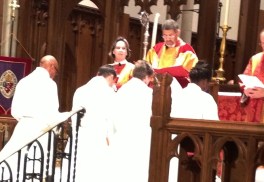 Three years ago I preached on this same passage from Luke’s gospel. I had just been ordained to the Transitional Diaconate a week earlier, and was back in Houston for Christmas break. I had been invited to serve as Deacon – for the first time – at St. Andrew’s, the parish that helped me on my vocational journey. I was a bit nervous and also thrilled to finally be doing what God had called me to do.
That day three years ago had begun three years before that. That’s when I made the decision to leave all that was familiar; to leave mother and father, brother and sisters and the rest of my family and friends. I left places of comfort, including the parish of St. Andrews, to embark on a new thing, in an unfamiliar place, where “what’s next” couldn’t be fully grasped.

St. Andrew’s Episcopal
So, to return to a familiar place after being ordained, surrounded by loved ones, those who supported me from afar, and to serve at that familiar altar – it was pretty surreal. I’m guessing Gretchen has some of these same feelings today, and I’m excited to see what the future holds for her.
Acts of Surrender
October 25, 2015
Christ Church Episcopal, Norcross, GA
The 22nd Sunday after Pentecost; Proper 25
Job 42:1-6, 10-17; Hebrews 7:23-28; Mark 10:46-52
(Gospel text is provided at the bottom of this post)
Surrender.
Tammy Pallot used that word as she shared her stewardship journey with us a couple of weeks ago. She described stewardship, ultimately, as an act of surrender.
 A few days later at the Wednesday Healing Eucharist, the word surrender emerged again. When looking at the previous Sunday’s gospel text, someone characterized Jesus’ instruction to the rich man – to sell all his possessions and give the money to the poor – that is, to leave everything and follow Jesus, as an act of surrender.
And, a few days later, at a continuing education conference, the word surrender came up again, when I came face to face with Centering Prayer. You see, when I enrolled in the conference, it was the topic that drew me in, and I hadn’t grasped that it would be not only a silent retreat, but also filled with several hours of centering prayer each day.
For those unfamiliar with centering prayer, as I was until last weekend, you sit in silence and in stillness for a designated amount of time – usually at least 20 minutes, but it can be more. And, in that silent stillness, you consent to God’s presence and action within you. Certainly an act of surrender.
As I reflect on today’s gospel lesson, I see several acts of surrender, as well.
First, it begins by telling us that Jesus and his disciples entered Jericho. Then, the very next sentence talks about them LEAVING Jericho, but now, there is a large crowd with them. We aren’t told what happened in Jericho – perhaps the original “what happens in Jericho, stays in Jericho” – but we know that SOMETHING happened, because people have surrendered their normal life – have left their homes – and are now following Jesus!
Next, as Jesus is walking along the road with this crowd of people, my guess is that he’s continuing to teach and share his Jesus-ness with them! Then all of the sudden, this blind man named Bartimaeus is on the side of the road and begins crying out,
“Jesus, Son of David, have mercy on me!” Many sternly ordered him to be quiet, but he cried out even more loudly, “Son of David, have mercy on me!”
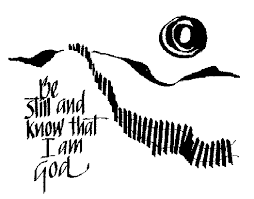 Now, Jesus could’ve kept on with his teaching; kept walking and never looked back. But, he had just admonished James and John for being all about the power and glory. Jesus had just said that “the Son of Man came not to be served but to serve, and to give his life a ransom for many.” (Mk 10:45) So, instead of going about his own plan for the day, Jesus surrendered. It says “Jesus stood still” – he stopped in his tracks and had them call Bartimaeus over to him.
And then it says “throwing off his cloak, [Bartimaeus] sprang up and came to Jesus.” You can sense his exuberance as he approached Jesus – thrilled to be noticed – someone who has been an outcast and beggar.
But, Jesus doesn’t just assume that he knows what the blind man wants, but instead asks him “What do you want me to do for you?” And Bartimaeus asks to get his eyesight back. While this may seem like a foregone conclusion to us, I wouldn’t be so sure.
This man has been blind for some time, we don’t know how long. He has found a way in life that seems to work, even though it may not be ideal. His basic needs are being taken care of, and no one is expecting too much from him. When his sight is restored, that will change. He will be transformed, not only physically, but society will perceive him differently. What’s more, his understanding of God will be transformed, too, and with it comes an acknowledgement of God’s generosity and mercy in his life.
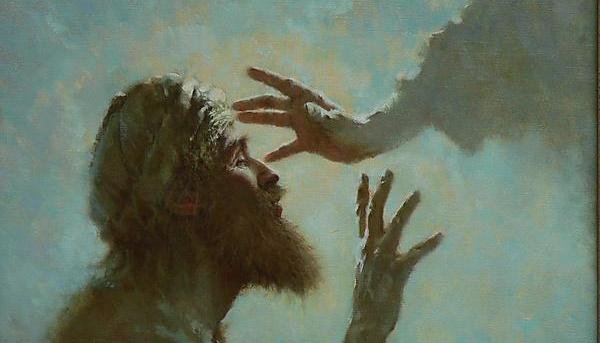 So, in responding to Jesus, Bartimaeus makes a choice to surrender to God:
The blind man said to him, “My teacher, let me see again.” Jesus said to him, “Go; your faith has made you well.” Immediately he regained his sight and followed him on the way.
The proof that this transformation was not just physical, is that Jesus says “Go” yet Bartimaeus, having surrendered himself fully, remained with Jesus – and followed him on the way. Having received the gift of sight, and with it, a transformed life, Bartimaeus surrendered that life to God.
I invite you this morning to think about where you find yourself in this story.
- Are you like one of those in the large crowd that has been touched by the word of God, and surrendered everything to follow Jesus?
- Or, are you consumed by the busy-ness of life; trying to keep everything together; struggling to find a way to simply stand still long enough to feel Jesus’ presence?
- Perhaps you are one crying out for Jesus to have mercy on you? If so, consider how you might answer his question “What do you want me to do for you?” Also rest in the assurance that God’s love and mercy is with you.
- Or, have you felt the power and love of Jesus in your life, like Bartimaeus did – and with renewed sight and a transformed life, chosen to freely give back to God?
We each may find ourselves in different places of this story at different times and circumstances in our life.  We are all on a journey that takes twists and turns, and we can find comfort in knowing that God is with us along the way.
I believe that part of our journey is the act of surrender to self by seeking God’s will for our lives, and in doing this, to give of ourselves – our time, talent and treasure – to God’s work in the world.
So, I ask you today, to surrender.
Gospel Text:
Jesus and his disciples came to Jericho. As he and his disciples and a large crowd were leaving Jericho, Bartimaeus son of Timaeus, a blind beggar, was sitting by the roadside. When he heard that it was Jesus of Nazareth, he began to shout out and say, “Jesus, Son of David, have mercy on me!” Many sternly ordered him to be quiet, but he cried out even more loudly, “Son of David, have mercy on me!” Jesus stood still and said, “Call him here.” And they called the blind man, saying to him, “Take heart; get up, he is calling you.” So throwing off his cloak, he sprang up and came to Jesus. Then Jesus said to him, “What do you want me to do for you?” The blind man said to him, “My teacher, let me see again.” Jesus said to him, “Go; your faith has made you well.” Immediately he regained his sight and followed him on the way. (Mark 10:46-52)

